Equations that can be integrated
Suppose that we are given the constant acceleration of
a train and wish to know the velocity and position at
future time t.
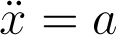
We start with the equation
where each 'dot' means differentiation with respect to
time.
We can integrate this directly to get the velocity ẋ
as a function of time
where b is a constant that we have to include to
represent the velocity at time t=0.
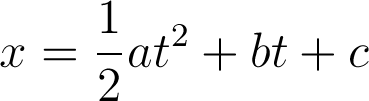
We can integrate this a second time to get the
position
and now we have to include c, the position x at time
t=0.
The solution is in two parts. The first is the
Particular Integral, the result of applying the input
a to the system.
The second is the Complementary Function, here
bt + c
that would have described the position of the train if
it had coasted along without any acceleration.
This system is 'second order', with the result that we
have to introduce two variables to match the output to
the Initial Conditions, here the position and speed at
t=0.
A harder problem
Real life systems are seldom as easy as a constant
input. The acceleration will usually depend on
the present values of the variables of a system, such
as air resistance depending on the velocity or spring
force depending on the displacement.
Often it can be impossible to find an 'analytic'
solution - a mathematical function - so it might be
necessary to 'simulate' the system to get a numerical
result. Here a second-order system would be
broken down into two first-order equations in the
'state variables', position x and velocity v.
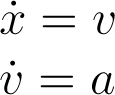
Taking the train example above we could write
and then at each time-step dt, add v*dt to x and a*dt
to v. Note that we still need two initial
conditions.
But when the interactions are 'linear', i.e. are just
proportional to the variables, we arrive at a
'homogeneous differential equation' which is
straightforward to solve.
Homogeneous differential
equations.
A homogeneous differential equation is one in which
derivatives appear 'alone', only multiplied by
constants and not as higher powers or products.
An example is
This might represent a mass-spring-damper system where
the spring produces a restoring force proportional to
displacement and the damper adds a force opposing the
velocity.
The method relies on noting that the time derivative
of
x = emt
is
ẋ = memt
so that each time we differentiate we pick up an extra
m.
If we guess that x might be of this form, our equation
becomes
m2emt + 5memt + 6emt = 0
or
(m2 + 5m +6)emt = 0
Now we do not want e
mt to be zero, so our
equation is solved if
(m2 + 5m +6) = 0
You should be able to spot that the two 'roots' of
this equation are
m = -2
and
m = -3
so to fit the equation, x could be e
-2t or
e
-3t
Or it could be a mixture of both. In fact by
setting x to be
x = Ae-2t +
Be-3t
we can choose A and B to fit the two initial
conditions.
Try this exercise. Click on
the question mark to see the answer.
ẍ + 5ẋ + 4x = 0
where at time t = 0, x = 3 and ẋ = 0
This time our
equation is
m2 + 5m
+4 =0
which has roots m=-1 and m=-4
so the solution is
x = Ae-t
+ Be-4t.
Now we have to fit A and B to the initial
conditions, so putting t=0 we have
A + B = 3
and differentiating to get ẋ we have
-A - 4B = 0
Adding these equations we get
-3B = 3
so B = -1
and substituting in the first we have
A = 4.
The solution is
x = 4 e-t
- e-4t
But it isn't all plain sailing
Now try
ẍ + 4ẋ + 4x = 0
where at time t = 0, x = 2 and ẋ = 0
This time there are repeated roots of -2.
We no longer have two functions with two variables A and
B to fit to the initial conditions. What has gone
wrong?
If we try substituting
x = te-2t
into the differential equation, we find that it
fits. (But only if there are repeated roots!)
So now we can write the solution as
x = Ae-2t + Bte-2t
and still get our two equations for the initial
conditions.
So what else can go wrong?
Complex roots
Suppose we try
ẍ + 2ẋ + 5x = 0
If we apply the formula for solving am
2+bm+c=0
m = (-b +/- root(b2 - 4 ac)/2a
we find roots
-1 + 2j
and
-1 - 2j
We now have exponentials of complex numbers!
But you have to remember that
e
(-1+2j)t = e
-te
2jt
and that
e2jt = (cos
2t + j sin 2t)
and
e-2jt = (cos
2t - sin 2t)
so the solution boils down to
x = e-t(Acos
2t + B sin 2t)
The particular integral
Since mentioning 'Homogeneous Equations' we have let the
input to our system be zero.
The functions that we have found are the 'Complementary
Function', the function of time that represents the
dying transient of a system that is undisturbed.
(Of course an unstable system does not die away!!)
To get the complete solution, we have to find a
'particular integral' that can fit the equation.
Then we can add the Complementary Function to match up
the initial conditions.
In the train example at the top, this was at
2/2,
which when differentiated twice gives the acceleration
a.
But in a vibration question, we are more likely to apply
a sine wave than a constant.
The answer to an exam or assignment question might not
even require the complementary function, since it is the
response after any initial transient has died away that
is important.
But finding the solution could be tough.
Consider the equation
We have already found the complementary function higher
up, but now we need a particular integral.
Since we are pumping a sine wave into the system with a
frequency of one radian per second, we can expect the
output to be a similar sinewave. But it is likely
to have a phase-shift.
There are several ways to represent it
mathematically. One is as
x= a cos t + b sin t
while another is as
x = c cos (t + phi)
where phi is a phase
angle in radians.
Using either of these is hard work - try them both.
You should get an answer
x = 0.1 cos t + 0.1 sin t
which is the same as
x = 0.1414 cos( t - pi/4)
But if you are brave enough to face up to complex
numbers, there is a much
easier way.
Yet more complications
Suppose that we have the following system with an input
at its 'resonant frequency':
ẍ + x = sin t
If we look for a mixture of sin t and cos t for x, we
end up with an answer that is infinite! Try it.
Once again an extra t has crept into the answer, which
has a particular integral
x = - (t cos t)/2
When you apply the input, the output does not suddenly
jump to infinity. It winds up linearly with time,
so that it would reach infinity an infinite time later,
if something did not limit or break first.
 Why that is the solution
Differential equations have two parts to their solution.
One part is called the 'complementary function' and
is the solution when the left-hand-side is equated to
zero.
The other part is the 'particular integral' and
represents the response to the function that is
applied on the right-hand-side.
So in this case the CF is the solution of
d2x/dt2
+ x = 0
while the PI is any function you can find to satisfy
d2x/dt2
+ x = sin(t)
But sin(t) and cos(t) both satisfy the CF equation -
so a mix of these will not do!
But if we try x = t.cos(t) what do we get?
dx/dt = -t.sin(t) + cos(t)
and
d2x/dt2
= -t.cos(t) - sin(t) - sin(t)
so
d2x/dt2
+ x = -2.sin(t)
so the actual answer we want is x = -t.cos(t)/2
Of course you can have additional sin(t) and cos(t)
terms to fiddle to match the initial conditions - that
is what the CF is for.