What are state equations?
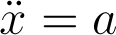
Suppose that we start with the equation that we saw
before,
where a is now a function of time and each 'dot' means
differentiation with respect to time.
By introducing the velocity v, we can break this down
into two first-order equations
dx/dt = v
and
dv/dt = a
The usefulness becomes clearer when we look at a
system where acceleration a is affected by x and v.
If we have a spring and a mass, we can write the
acceleration as
a = - x k/m
so
ẍ + x k/m = 0
and we can spot solutions with the sines and cosines
of t root(k/m).
But suppose that we add some damping, so that
a = - b x - c v
i.e. we have the familiar second order equation
ẍ + c ẋ + b x =0.
Suppose that instead of the second order equation we
look at the pair of first-order equations
dx/dt =
v
dv/dt = - b x - c v
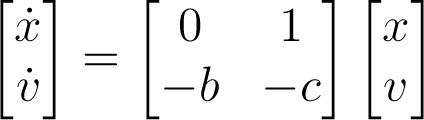
If we define a vector
x to be (x, v)' we can write the
equations in matrix form as
or
ẋ = A x
So how does that help?
If we can start
x off as an
eigenvector of A,
then it will satisfy
ẋ = λ x and
the solution will be
x = x(t=0)
eλt
We can express
any
initial
x
as a combination of the eigenvectors, and so the
solution will be of the form
x = a1
eλ1t + a2
eλ2t + a3 eλ3t
....
For the simple problems it might look complicated, but
when we get onto problems with multiple masses,
springs and dampers it is all worth while.
Simulation
The concept of state variables arose in the days when
simulations used operational amplifiers full of
valves. But they are just as useful today for
simulating a system on a digital computer.
All the equations are now first order, so the
rate-of-change of each variable is expressed as a
function of all the variables and the inputs. If
we define a small time-step dt, we can say that the
new value of x after the time step is
x + ẋ dt
Of course this is an approximation, but if we halve dt
and then run the simulation again we can decide if dt
is small enough. If there is any significant
difference between the simulations, halve it again.
The method works even if the equation is nonlinear, so
that you can simulate systems that you cannot solve
mathematically.