A close look at matrices
1. Introduction.
There is a tendency among mathematicians to regard
matrices as arcane and mystic entities, with cryptic
properties which reward a lifetime of study. Engineers
can be duped into this point of view if they are not
careful.
Matrices are, in fact, just a form of shorthand that
can come in very useful when a lot of calculating
operations are involved. There are strict rules
to observe, but when used properly they are mere tools
which are the servant of the engineer.
You will probably have first encountered matrices in
the solution of simultaneous equations.
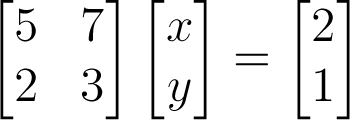
To take a simple example, the equations:
5
x + 7 y = 2
and
2
x + 3 y = 1
can be "tidied up" by separating the coefficients from
the variables in the form:
where the variables are now conveniently grouped as a
vector.
Now this 'close relationship' with simultaneous
equations forces a convention on us that will haunt us
in almost every application! For a start, we are
generally committed to representing our vectors as
'columns', one number above the other. We can
easily include in our technical paper the expression
A z = b
but when we want to list the value of
z we must either take
up a couple of text lines with coefficients one above
the other, or else give the value of its 'transpose'
and write
(x, y)T
or
(x, y)'
Now the multiplication rule has defined itself.
We move across the top row of the matrix, multiplying
each element by the corresponding component as we move
down the vector, adding up these products as we
go. The total is the top element of the vector
result, here
5 x + 7 y.
Then we do the same for the next row, and so on.
2. More on vectors
So what does a vector actually 'mean'? The
answer has to be, "anything you like". Anything,
that is, that cannot be represented by a single number
but requires a string of numbers to define it.
It could even be a shopping list.
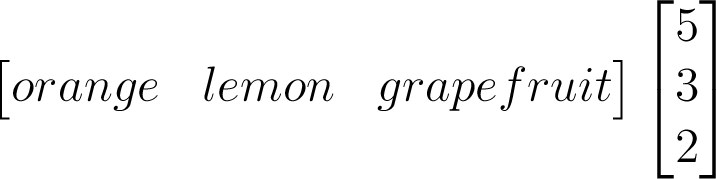
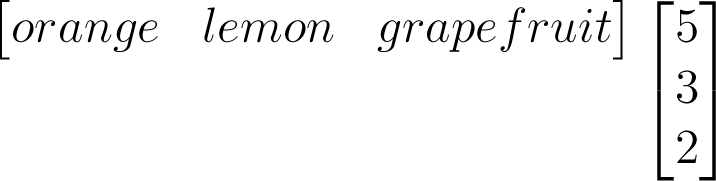
5 oranges + 3 lemons +
2 grapefruit
can be written as
or
(orange, lemon,
grapefruit) (5, 3, 2)'
where the 'dash' denotes a transpose, or else put the
dot between them that we use for 'scalar
product'. The numbers on the right have defined
a 'mixture' of the items on the left.
Rather than fruit, we are more likely to apply vectors
to coordinate systems - but we are still just picking
from a list.
We might define
i,
j and
k to be
'unit vectors' all at right angles, say East, North
and Up. We can call them 'basis vectors'.
When we say that point P has coordinates (2, 3, 4)' we
mean that to get there you start at the origin and go
two metres East, then three metres North and 4 metres
Up.
We could write this as
2 i + 3 j + 4 k
a mixture of the basis vectors defined by a
matrix multiplication - vectors are just skinny
matrices.
Now when we turn our minds to applications, we can see
many uses for vector operations. When a force
F moves a
load a distance
x, the work done is given by
their scalar product
F .
x
As before we take products of corresponding elements
and add them up, to get a scalar number.
We usually think in terms of "the matrix multiplies
the vector". But how about thinking of the
vector multiplying the matrix? What does it do
to it?
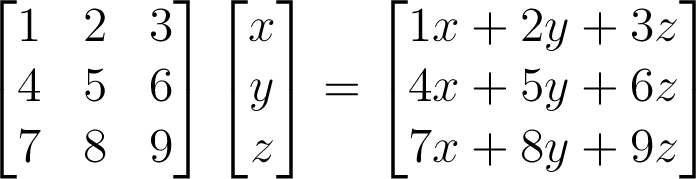
Well from one point of view, the top element of the
answer on the right is equal to the scalar product of
the top row of the matrix with the vector (x, y, z)'.
Similarly the other elements are the scalar products
of the vector with the middle and bottom rows of the
matrix, respectively.
So we have
The product of a matrix and a
(column) vector is made up
of the scalar products of the vector with
each of the rows of the matrix
|
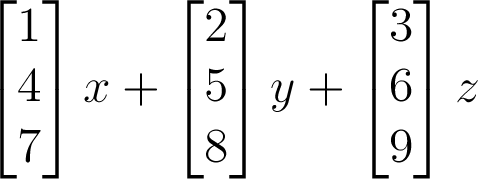
But there is another way of
seeing it. The answer is the same as:
The product of a matrix and a column
vector is a mixture of the vectors that make
up the columns of the matrix
|
So if instead of describing P by the sum of components
i,
j and
k of our
basis vectors, we based its coordinates (x, y, z)' on
three other vectors
u,
v and
w, then
we could 'transform the coordinates' by multiplying
(x, y, z)' by a matrix made up of columns representing
vectors
u,
v and
w to
end up with a vector for P as a mixture of
i,
j and
k.
3. Matrix multiplication.
Often we will find a need to multiply one matrix by
another. To see this in action, let us look at
another simple 'mixing' example.
In a sweetshop, "Sucks", "Munches" and "Chews" are on
sale.
Also on sale are "Jumbo" bags each continuing 2 Sucks,
3 munches and 4 Chews,
and "Giant" bags containing 5 Sucks, 6 Munches and
only one Chew.
If I purchase 7 Jumbo bags and 8 Giant bags, how many
of each sweet have I bought ?
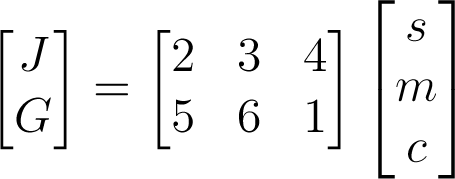
The bag contents can be expressed algebraically as:
J
=
2 s + 3 m + 4 c
and
G
=
5 s + 6 m + 1 c
or in matrix form as:
Note that matrices do not have to be square, as long
as the terms to be multiplied correspond in number.
Now my purchase of 7 Jumbo bags and 8 Giant bags can
be written as:
7
J + 8 G
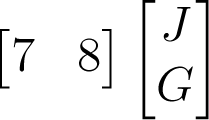
or in grander form as the product of a row vector with
a column vector:
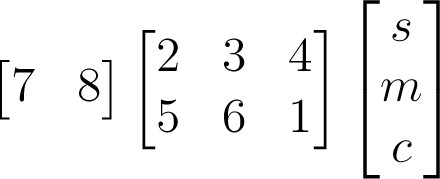
But I can substitute for the J, G vector to obtain:
To get numerical counts of sucks, munches and chews we
have to calculate the product of a numerical row
vector with a numerical
matrix. As before, we march across the row(s) of
the one on the left, taking the scalar product with
the columns on the right.
The answer is what common sense would give.
From 7 Jumbo bags, with Sucks at 2 to a bag, we
find 7 times 2 sucks.
From 8 Giant bags we find 8 times 5 more, giving a
grand total of 54.
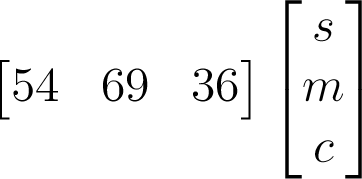
The final answer is
i.e. 54 Sucks, 69 munches and 36 chews.
Now the shop is selling an Easter bundle of 3 Jumbo
bags and a Giant bag,
and still has in stock Christmas bundles of 2 Jumbo
bags and 4 Giant bags.
In no time we can write:
In effect, it is a sort of transformation.
Exercise:
If I buy 5 Easter packs and one Christmas pack, how
many sucks, munches and chews will I have?
Write down the matrices involved and multiply them out
by the rules we have found.
(Your answer should be 79 sucks + 105
munches + 77 chews)
The mathematician will still worry about the order in
which the matrix multiplication is carried out.
We must not alter the order of the matrices, but we
can group the pairs for calculation in two ways.
The Christmas and Easter bags can first be opened to
reveal a total of Jumbo and Giant bags,
then these can be expanded into individual sweets,
or alternatively the total of each sweet for a
Christmas bag and for an Easter bag can be worked out
first;
the result must be the same. (Check it)
The mathematicians would say that "multiplication of
matrices is associative" - i.e.
A B C
= (A B) C = A (B
C)
P3.3. Transposition of matrices.
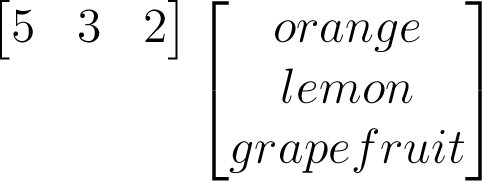
Our mixed fruit multiplication can be written as
or equally well as
giving 5 oranges + 3 lemons + 2 grapefruit in both
cases - this result is in the form of a scalar.
But note that in reversing the order in which we
multiply the vectors, we have had to transpose them.
Now transposing a scalar is not very spectacular - but
when two matrices are multiplied together to give
another matrix,
C
= A B
then if we wish to find out the transpose of C we must
both transpose A and B and reverse the order we
multiply them in.
C'
= B' A'
So you see that if we had been prepared to write our
equations in the form
x'
A'
rather than
A
x
we could happily have dealt in row vectors instead of
column vectors.
Some of the expressions for moving an object around
with several transformations would have made more
sense, too!
But we are locked in to the conventions as they stand,
so enough of grumbling!
4. The unit matrix
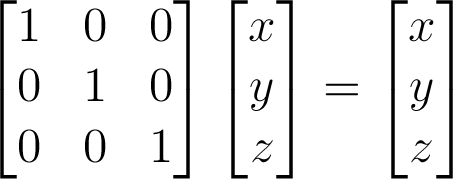
One last point to note before moving on is that:
The matrix with 1's down its diagonal and 0's
elsewhere has the special property that its product
with any vector or matrix leaves that vector or matrix
unchanged. Of course, there is not just one unit
matrix, they come in all sizes to fit the rows of the
matrix they have to multiply. This one is the 3
x 3 version.
5. Coordinate transformations.
I mentioned above that vector geometry is usually
introduced with the aid of three orthogonal unit
vectors
i,
j and
k.
For now, let us keep to two dimensions and consider
just (x, y)', meaning x
i +
y
j.
Now suppose that there are two sets of axes in
action. With respect to our first set the point
is (x, y)'
but with respect to a second set it is (u, v)'.
Just how can these two vectors be related ?
What we have in effect is one pair of unit vectors
i and
j, and
another pair
l and
m, say.
Since both sets of coordinates represent the same
vector, we have:
x i
+
y j
=
u
l
+
v m
Now each of the vectors
l and
m must be
expressible in terms of
i and
j.
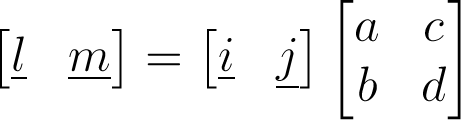
Suppose that
l
= a i + b j
and
m
= c i + d j
or in matrix form:
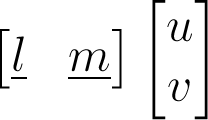
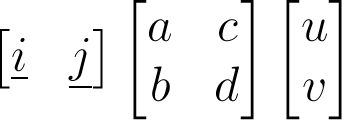
We want the relationship in this slightly twisted
form, because we want to substitute into
to eliminate vectors
l and
m to get:
Now the ingredients must match, i.e.
Although this exercise is now graced with the name
"vector geometry", we are merely adding up mixtures in
just the same form as the antics in the
sweetshop.
To convert our (u, v)' coordinates into the (x, y)'
frame, we simply multiply the coordinates by an
appropriate matrix which defines the mixture.
Suppose however we are presented with the values of x
and y and are asked
to find (u, v)'. We are left trying to solve two
simultaneous equations:
x
= a u + c v
and
y
= b u + d v
In traditional style we multiply the top equation by d
and subtract c times the second equation to obtain:
d
x - c y = (ad - bc) u
and in a similar way we find
-b x + a
y = (ad - bc) v
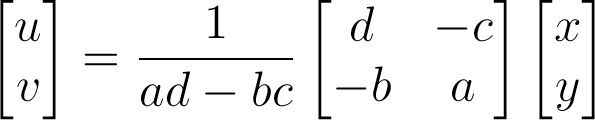
which we can rearrange as
where the constant 1/(ad - bc) multiplies each of the
coefficients inside the matrix.
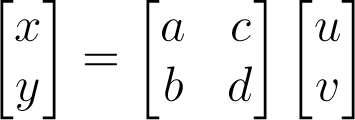
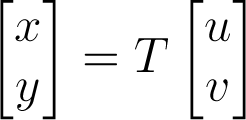
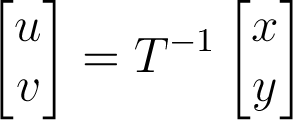
If the original relationship between (x, y)' and (u,
v)' was
then we have found an 'inverse matrix' such that
The value of (ad - bc) obviously has special
importance -
we will have great trouble in finding an inverse if
(ad - bc) = 0.
Its value is the 'determinant' of the matrix T.
6. Matrices, notation and
computing.
In a computer program, rather than using separate
variables x, y, u, v and so on,
it is more convenient mathematically to use
"subscripted variables" as the elements of a
vector.
The entire vector is then represented by the single
symbol
x,
which will be made up of elements
x
1, x
2 and so on.
Matrices are now made up of elements with two
suffices, thus:
|
A =
|
a11
a12 a13
a21 a22 a23
a31 a32 a33
|
|
In a computer program, the subscripts appear in
brackets, so that a vector could be represented by the
elements X(1), X(2) and X(3), while the elements of
the matrix are A(1,1), A(1,2) and so on.
It is in matrix operations that this notation really
earns its keep. Suppose that we have a
relationship
x
=
T
u
where the vectors have three elements and the matrix
is 3 by 3. Instead of a massive block of
arithmetic,
the entire product is expressed in just five lines of
Basic program:
FOR
I=1
TO
3
X(I)=0
FOR J=1 TO 3
X(I)=X(I)+T(I,J)*U(J)
NEXT J
NEXT I
For the matrix product C = A B the program is
hardly any more complex:
FOR I=1
TO 3
FOR J=1
TO 3
C(I,J)=0
FOR K=1
TO 3
C(I,J)=C(I,J)+A(I,K)*B(K,J)
NEXT K
NEXT J
NEXT I
or in Java or C it becomes:
for( i =
1; i<=3; i++){
for( j = 1; j<=3; j++) {
c[i][j] = 0;
for (k = 1;
k<=3;k++) {
c[i][j]
+= a [i][k]*b[k][j];
}
}
}
These examples would look almost identical in a
variety of languages and would show the same economy
of programming effort.
In Matlab the shorthand of matrix operations goes even
further - but there is a danger that the engineroom
will be lost to view behind the paintwork.
Clearly if we
are to try to analyse any but the simplest of
systems by computer,
we should first represent the problem in a
matrix form.
|
But beware!!
| If you have no
computer to hand, it will almost certainly be
quicker, easier and less prone to errors to
use non-matrix methods to solve the problem. |